Tema 'Amianto natural, NOA'
Número especial de la revista Journal of Environmental and Engineering Geoscience (E&EG), volumen 26, número 1, febrero de 2020
Este número especial de la revista Journal of Environmental and Engineering Geoscience (E&EG) es un resumen de los artículos presentados en un simposio sobre «Amianto de origen natural (NOA)», celebrado en el marco del XIII Congreso de la Asociación Internacional de Geología de Ingeniería y Medio Ambiente (IAEG) y la Reunión Anual de la Asociación de Geólogos Ambientales y de Ingeniería (AEG) en San Francisco en septiembre de 2018.
Nuestro colega, el Dr. Stefan Pierdzig, también participó en este simposio por invitación y realizó una presentación sobre la situación en Alemania en relación con la gestión del amianto natural.
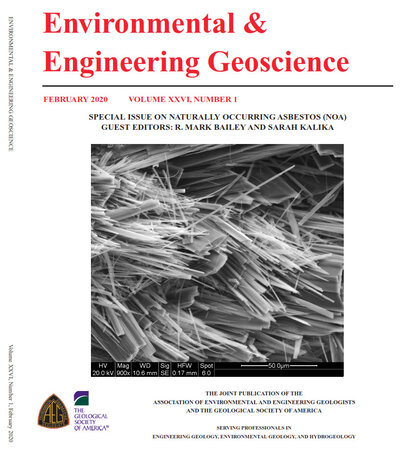 RESEARCH ARTICLE | FEBRUARY 20, 2020
Regulations Concerning Naturally Occurring Asbestos (NOA) in Germany—Testing Procedures for Asbestos
Stefan Pierdzig
Environmental and Engineering Geoscience (2020) 26 (1): 67–71.
https://doi.org/10.2113/EEG-2278
ABSTRACT
In Germany, potential asbestos-containing rocks are used as raw materials for a number of engineering applications. These rocks are ultrabasites (dunite, harzburgite), igneous rocks (basalt, gabbro, norite), and metasomatic or metamorphic rocks like talcum, greenschist and amphibolite. Based on the German Gefahrstoffverordung (Hazardous Substances Ordinance), regulatory statutes exist for operations using these rocks and resultant composites and products.
The authorities state that in Germany no natural rocks exist with more than 0.1 mass-% of one of the six regulated asbestos minerals. But it is well known that there are rocks with a high modal concentration of these minerals with a non-asbestiform, columnar to prismatic habitus. Under mechanical stress during handling, they can lead to fibrous cleavage fragments, which conform to the World Health Organization (OMS) “respirable asbestos fiber” definition. In view of this fact, the regulations changed in 2009, with revision of the Technical Rules for Hazardous Substances (TRGS) 517: any fibrous asbestos particles, regardless of whether or not they represent naturally occurring asbestos or are of cleavage origin, are evaluated for potential hazards associated with handling of these rocks.
If the OMS fiber concentration is <0.1 mass-%, rocks and products can be used and re-used under protective measures. At concentrations >0.1 mass-%, the material is considered hazardous waste.
These regulations apply to many industrial sectors that exploit and process rocks, using them in road building and track construction and when they are recycled. Analysis (by scanning electron microscopy, SEM/energy dispersive x-ray spectroscopy, EDS) to determine the asbestos concentration of rocks, gravels, or dusts is carried out in the <100-µm, grain-size fraction produced by sieving or grinding. The results provide a representation of a worst-case examination of the air quality during mechanical treatment of these materials. Workplace monitoring is done by air sampling to survey an exposure limit of 10,000 fibers/m3 of air (0.01 f/cc).